)
AI, Feed, and Automation in Aquaculture: Precision, reliability, and the shift toward predictive farming
As aquaculture intensifies to meet global protein demand, producers are confronting rising biological variability, complex feeding environments, and increasing pressure to deliver consistent performance.
Meanwhile, AI‑enabled feeding systems, imaging tools, and precision nutrition platforms are maturing at pace - reshaping how farms understand their animals and make daily decisions. As a result, the sector is steadily transitioning from manual observation and intuition toward structured, predictive, and biologically informed ways of farming.
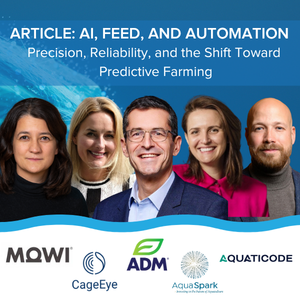
Ahead of the Blue Food Innovation Summit 2026 in May, Aquaticode, CageEye, AquaSpark, ADM, and Mowi share insights that reveal a shared recognition of AI’s potential - alongside the operational realities that must be addressed for these technologies to scale successfully.
Where AI, Automation, and Precision Tools Are Making the Biggest Impact Today
Across contributors, one pattern stood out clearly: AI is already helping producers make earlier, more accurate biological decisions - particularly in feeding and early‑stage cohort optimisation.
Stian Rognlid, CEO & Co-Founder at Aquaticode, highlights how AI is unlocking earlier insight than ever before: “AI phenotyping is emerging as a new category… When early biological information becomes actionable, producers can build more predictable cohorts and improve downstream performance.” Rognlid explains that aquaculture has historically excelled at optimising equipment, feed, and environmental management - yet lacked early visibility into biological variation. With AI‑driven phenotyping, producers can now identify traits linked to survival and growth much sooner, stabilising production and creating more uniform groups.
Feeding automation is another area of rapid adoption. Ragnhild Dragøy, CEO at CageEye, notes that operators face increasing complexity while relying on limited tools: “Near‑term opportunities for AI lie in structuring and analysing all available data sources to give a clear, objective picture of what’s happening  in the pen.”
Dragøy explains that operators juggle behaviour interpretation, pellet visibility, oxygen levels, currents, and temperature changes - often through a single camera. AI brings structure and consistency by integrating these signals into a unified understanding. She adds that the next frontier will be feeding aligned with fish behaviour rather than human visibility, relying on acoustics and advanced behavioural inference.
Maria Velkova, Chief Portfolio Officer of Aqua Spark, emphasises that many of these systems are now considered essential farm assets: “AI‑enabled camera systems and automated feeding platforms are increasingly becoming core farm infrastructure… helping farmers feed more precisely and respond earlier to biological signals.”
Velkova highlights that even small improvements in feed conversion ratio (FCR) can drive large environmental and economic benefits, especially in salmon. Meanwhile, shrimp producers are beginning to adopt image‑based tools that provide early insight into biomass variation and stress.
Pierre‑Joseph Paoli, President of Growth & Commercial Excellence at ADM, shows how precision nutrition is evolving in parallel with feeding automation: “By delivering advanced insights and consistent value, we are strengthening customer trust and securing long‑term business growth.” Paoli points to real-world gains - from improved feed formulation accuracy to cost‑efficient cholesterol alternatives, demonstrating how data‑driven nutrition enhances performance across species.
Together, these perspectives illustrate a sector discovering the tangible benefits of earlier biological insight and more objective, consistent feeding decisions.
Barriers Slowing Adoption - And What Must Change to Unlock Scale
While enthusiasm for AI is strong, adoption is slowed by operational realities, variability in biological systems, and the need for trust and reliability in high‑stakes environments.
Stian Rognlid, CEO & Co-Founder at Aquaticode, stresses that the challenge is not willingness - it's operational fit: “The main barrier is not interest, it is integration. Solutions must work reliably at commercial speed, create clear economic value, and fit into workflows producers already trust.” Even robust tools fail if they disrupt established routines or require additional handling that risks fish welfare.
 Aqua Spark's Maria Velkova points to biological unpredictability as another major challenge: “Fish and shrimp operate in complex, constantly changing conditions - technologies must perform reliably across a wide range of scenarios.” Conditions can shift rapidly, she notes, meaning systems must cope with fluctuations in behaviour, density, temperature, and water quality. Advances in sensors and machine vision are helping, but reliability remains paramount.
CageEye's Dragøy emphasises that feeding systems face uniquely high expectations: “Feeding has to happen every day, and downtime is unacceptable. Hardening and reliability are the primary focus.” She observes that feeding is both technical and cultural - deeply tied to farmer expertise and intuition. Technology must respect this identity, augmenting rather than replacing operator judgement.
Paoli of ADM, highlights another barrier: converting raw data into meaningful guidance. “There is a big difference between data and insights - farmers need help determining which insights matter and how to act on them.” He stresses that clarity, not complexity, drives adoption.
Taken together, these viewpoints point to four essentials for successful adoption: reliability, integration, interpretability, and strong alignment with real farm workflows and culture.
Lessons From Early Adopters: Culture, Clarity, and Co‑Development
Early adopters demonstrate that scaling AI is as much about people and processes as it is about technology.
Dragøy underscores the importance of working closely with farmers from planning to deployment: “Tradition and tech have to go hand in hand… tech providers must work closely with customers to facilitate change management.” She explains that co‑development ensures tools reflect real operational rhythms, while giving farmers ownership over the technology's evolution.
Velkova emphasises that technology must be truly embedded into decision-making: “Farmers don’t need more dashboards - technology must help them make better decisions around feeding, health, and production planning.” She stresses that adoption accelerates when systems simplify decisions and fit seamlessly into daily routines.
 Catarina Martins, Chief Technology and Sustainability Officer at Mowi, offers a structured framework drawn from global implementation experience: “Start with the problem, not the device… Technologies succeed when anchored to a clear bottleneck such as feed efficiency, mortality reduction, or labour shortage.” Martins highlights the importance of data quality, strong SOPs, staff training, and trust. AI thrives only when digital and biological systems operate as one unified model.
Paoli reinforces the value of strong feedback loops: “We aim to stabilise variability and build a data feedback loop so adjustments can be made to support performance targets.” Paoli notes that continuous interpretation and refinement are critical to long‑term success.
Across these insights, one lesson stands out: effective adoption isn’t defined by the sophistication of the technology - but rather by the strength of operational discipline and organisational readiness behind it.
Partnerships That Move Innovation From Pilot to Commercial Reality
Across all expert perspectives, one theme emerges clearly: scaling AI in aquaculture is fundamentally a partnership challenge - not a technology challenge.
Ragnhild Dragøy, CEO of CageEye, highlights farmer‑led co‑development as the strongest route to scalable adoption: “Direct partnerships with farmers are the most efficient way to move from pilots to commercial scale.”
She explains that when farmers test and shape tools in real farm environments, solutions align naturally with practical realities - from feeding rhythms to environmental conditions. Dragøy also stresses the value of collaboration across complementary technologies. By bringing acoustics, cameras, sensors, and analytics into integrated systems, technology providers reduce complexity and lower adoption barriers.
Paoli adds a supply‑chain view centred on transparency and role clarity: “When everyone is clear from the start on what they bring and how value is shared, collaboration succeeds.”
He emphasises that ADM’s strongest partnerships are those that combine feed expertise, traceability technologies, transportation optimisation, and cloud‑based data systems. These multi‑layered collaborations enhance reliability and scalability. He also notes that scaling introduces new operational demands, particularly for hardware, maintenance, and on‑farm integration - underscoring the necessity of clear frameworks and shared accountability.
Together, these perspectives make it clear that the innovations most likely to scale are those developed with farmers, supported by transparent data practices, and reinforced by ecosystems of complementary partners.
Looking Ahead to the Blue Food Innovation Summit in May
Across all expert perspectives, it’s clear that AI, precision feeding, and predictive biological management are reshaping the foundations of aquaculture. Yet the transition from promising innovation to practical, scalable solutions is still unfolding, and many of the most important questions now sit at the intersections of biology, technology, and operational culture.
These are exactly the themes that will be explored in far greater depth at the Blue Food Innovation Summit in London on May 27-28, where producers, technology developers, feed companies, investors, and policymakers will examine what it will take to unlock the next wave of progress.
Secure your place today and be in the room as these industry leaders take to the main stage in London on May 27-28.
)
)
)
)
)