)
Catalysing the Blue Food Transition: Priorities for Scale, Impact, and Resilience
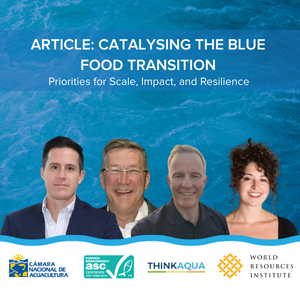
From climate volatility and shifting consumer expectations to supply‑chain pressures and expanding regional demand, the blue food sector faces both structural challenges and unprecedented momentum entering 2026. As policy, investment, and innovation converge, leaders across aquaculture and fisheries are rethinking what sustainable growth should look like, and how to achieve it.
In the build-up to the Blue Food Innovation Summit 2026, we gathered perspectives from the Ecuador National Chamber of Aquaculture, ASC, ThinkAqua, and the World Resources Institute. Their insights reveal both shared priorities and distinct viewpoints that together spotlight where the blue food sector is heading.
Evolving Consumer Priorities Are Reshaping Global Demand
As global diets shift and health awareness rises, blue foods are entering a new phase of consumer relevance. People are demanding proteins that not only deliver high nutritional value but also fit into increasingly fast‑paced, budget‑conscious lifestyles. At the same time, market preferences are fragmenting across regions, with different populations seeking different species, formats, and culinary experiences. Understanding this evolving landscape is central to capturing future growth - and to ensuring blue foods become everyday staples rather than occasional choices.
 José Antonio Camposano, Executive President, Ecuador National Chamber of Aquaculture, underscores this change: “Across global markets, three forces are clearly converging: the search for lean protein, affordability, and convenience… Blue foods are uniquely positioned in this space… They are adaptable across meal occasions: breakfast, lunch, and dinner. In other words, blue foods should be framed as all-day proteins.”
He highlights that consumers are not abandoning protein under economic pressure - they are optimising it. Ready‑to‑cook, portion‑controlled, and value‑added formats, he notes, are critical to helping blue foods integrate into daily routines.
Anton Immink, CEO, ThinkAqua, observes a similar trend from a regional perspective: “General shifts towards greater middle class prosperity in Asia and Africa are driving demand for higher value species. In Asia consumers are demanding species like salmon and seabass… In Africa, better-off consumers desire larger tilapia.”
Immink points out that while this growing appetite for premium species is promising, it also increases demand for fishmeal and feed ingredients, placing new pressures on upstream supply chains.
Together, their perspectives suggest that while global demand is rising, broadening the appeal of blue foods will require greater accessibility, consumer education, and innovations in product form.
Where Does the Greatest Scaling Potential Lie?
As global demand rises, the sector is grappling with a fundamental question: which species are truly positioned to scale sustainably in the coming decade? Different production systems offer different advantages - from well‑established species with robust supply chains, to lower‑profile aquatic foods that support nutrition and livelihoods at massive scale. Determining where to prioritise investment will shape not only global seafood availability but also the economic and social benefits that flow back to producers and communities.
Camposano sees shrimp as a standout candidate for sustainable scaling:
“Shrimp stands out… Production systems have matured, disease management has improved, genetics have advanced, and supply chains are highly developed… Shrimp is increasingly recognized globally… not only as a luxury item but as a routine protein option.”
He notes that COVID‑era home cooking helped dismantle long‑held assumptions about seafood being difficult to prepare, unlocking new household adoption.

Chris Ninnes, CEO, Aquaculture Stewardship Council, urges the industry to broaden its perspective. He emphasises that salmon, despite its visibility, represents only a small portion of global production:
“Atlantic salmon has historically dominated the narrative… yet it represents less than 3% of global farmed seafood.” For Ninnes, true scaling potential lies with species that sustain livelihoods and food security: “If we want to talk about livelihoods and food security, then carp, seaweed, oysters, mussels, and crayfish contribute far more in terms of volume, nutrition, and rural employment.”
While Camposano highlights the commercial maturity and global familiarity of shrimp, Ninnes encourages the sector to recognise the foundational role of high‑volume, lower‑profile species in feeding the world.
Geographic Diversification & Regional Resilience: Opportunity vs. Reality
As climate variability intensifies and geopolitical dynamics reshape trade flows, the blue food sector faces growing pressure to diversify where production happens, and to do so in a way that is both resilient and regionally appropriate. Some regions offer tremendous long‑term potential due to natural resources and market dynamics, but they often lack the supporting infrastructure, services, and regulatory conditions that make scaling viable. Understanding these regional disparities is essential for building a truly global blue food system.
Looking at regional dynamics, Ninnes offers a candid assessment of global production capacity: “Africa and Latin America represent major long‑term opportunities… but the sector there is constrained by limited development and infrastructure… The potential is huge, but the foundation is still being built.”
He also underscores the need for region‑appropriate sustainability approaches: “Only about a quarter of all farmed seafood is destined for markets that demand sustainability certification… A one‑size‑fits‑all model won’t work.” Technology, he argues, is becoming central to ensuring integrity and trust: “Technology is increasingly being applied at smaller scales across India, Indonesia, and many other Asian countries… Remote sensing… adds confidence and reduces the risk of fraud.”
These perspectives resonate with Immink’s emphasis on supporting smallholder farmers - particularly in regions where access to inputs, markets, and services remains uneven. Together, they highlight that scaling blue foods globally requires long‑term investment in regional infrastructure, capacity, and technology‑enabled verification.
Feed Systems: Innovation Through Ingredients and Circularity
Feed remains one of the most consequential levers for reducing aquaculture’s environmental footprint and ensuring long‑term sector resilience. With rising production volumes and expanding species portfolios, producers face increasing pressure to diversify inputs, reduce emissions, and stabilise costs - all while maintaining nutritional performance. The industry is moving beyond a narrow focus on fishmeal alternatives toward a broader reimagining of how feed ingredients are sourced, recycled, and integrated.
Feed innovation emerged as a clear priority across expert perspectives. Immink notes a shift in mindset among feed producers: “Feed producers are increasingly understanding the carbon footprint and identifying ingredient sources that can help reduce that. It is starting to reshape the debate around fishmeal, soy and by-product ingredients.”
He sees the industry moving toward more carbon‑aware sourcing decisions that can lower environmental impact without compromising performance.
Abigail Frankfort, Aquatic Food Lead, World Resources Institute, expands this further by emphasising the potential of circularity: “Much more can be done to use innovative ingredients, such as algae and by-products of the fishing industry.” Frankfort also highlights the untapped opportunity to connect seaweed, aquaculture, and fishing sectors: “This can not only reduce costs, but the emissions and ecosystem impacts across these value chains.”
Together, their insights suggest that while the path to lower‑impact feed systems is multifaceted, it will ultimately rely on both better ingredient choices and stronger cross‑industry linkages.
The Collaboration Imperative: Systemic Change Requires Shared Action
Achieving meaningful, scalable progress in blue foods requires an unprecedented level of cooperation - not just within aquaculture, but across feed, finance, retail, and policy ecosystems. Producers alone cannot meet rising sustainability expectations or shoulder the costs of transformation. Instead, the sector must embrace new partnership models that enable knowledge‑sharing, cost‑sharing, and coordinated action at scale.
Collaboration emerged as a consistent theme across nearly all answers. Immink emphasises the need for shared responsibility in reducing environmental impact: “Collaboration is needed up and down the supply chain… For smallholder farmers to thrive, collaborative business models are required that provide equitable access to inputs, services and markets.”
Camposano believes the biggest missing piece lies in consumer awareness: “One of the most significant barriers is the absence of coordinated marketing, promotion, and consumer education… Blue foods do not need reinvention. They need integration into everyday life.”
Frankfort adds that despite their value, blue foods remain underrepresented in policy and retail strategies: “Blue foods are often sidelined. Retailers and policy makers must better represent these food products in their decision‑making.” Their perspectives paint a holistic picture: strengthening blue food systems will require improved farmer support, unified consumer messaging, and far greater policy recognition.
Looking Ahead to the 2026 Summit
Across all viewpoints, several shared priorities emerge:
- Blue foods are well‑positioned to meet rising global demand, but broader adoption depends on education, affordability, and product innovation.
- Scaling efforts must recognise the diversity of species that support global food security.
- Regional growth potential is significant but will require long‑term investments in infrastructure, inputs, and verification systems.
- Feed innovation and circularity hold major promise for reducing environmental impact and improving resilience.
- Collaboration across supply chains, policymakers, retailers, and producers is essential to drive systemic change.
These insights set the stage for the Blue Food Innovation Summit 2026, where global leaders will continue exploring how the sector can scale equitably, sustainably, and strategically in an increasingly complex sector.
)
)
)
)
)