)
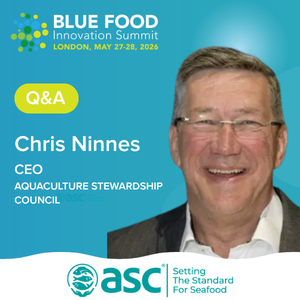
The Global Blue Food Equation: A Q&A with Chris Ninnes
How are shifting consumer priorities toward nutrition, sustainability, and affordability reshaping demand for blue foods across different global regions?
"It depends where in the world you eat your seafood. Globally, as reported by FAO, 60% of all the protein consumed globally comes from plants. Generally, in western societies health and environmental concerns has seen reduced consumption of red meats over time. Seafood and chicken sales have benefitted, as have ingredients used in vegetarian and vegan diets. In Japan seafood consumption has been declining for many years and meat is now more popular than seafood. For most of the rest of the world seafood is a much valued source of animal protein, important in the diets of billions. Seafood consumption globally continues to increase, especially as increased affluence drives choice.
Seafood farming is no longer just an alternative to wild fisheries - it is a cornerstone of modern food systems and maritime economies. In 2022 total seafood production reached 223 million tonnes (185.4 of aquatic animals and 37.8 of seaweed). With total farmed seafood production of 130.9 million tonnes, which has surpassed capture fisheries production for most of the last decade, 94.4 million tonnes of farmed animals were produced. This represented the first-time farmed production surpassed that of wild caught with 51% of the total farmed animal production. By 2025, FAO reported that farmed animal production supplied more than 56% of the world’s total.
Turning to fish production, especially viewed through the important lens of food security and livelihoods, seafood farming is hugely important. First a couple of important ‘big’ numbers. Seafood already provides over 3 billion people with at least 20% of their animal protein. Seaweed and fish are nutritionally, superfoods. Literally. The presence of many micro-nutrients and minerals, often at concentrations not available from terrestrial foods, is staggering. The benefits to the cognitive development of young children when pregnant and nursing mothers eat seafood is significant; perhaps as high as an eight point boost to IQ. The nutritional benefits of seafood are well known. Why the wider promotion is not more prominent is a failure of national and global policy."
Which aquatic species or production systems currently show the strongest potential for scaling sustainably and what makes them commercially attractive right now?
"At a top level, seafood farming is generally considered to have a lower environmental footprint than terrestrial protein production. These impacts differ across species and production systems and those requiring fewer inputs (especially of feed, energy and CapEx costs) have smaller footprints. Lower trophic species, when fed, require lower protein inputs from either marine or terrestrial ingredients and associated diets have lower footprints. The impacts associated with feed use can contribute up to 60–70% of the total footprint of seafood farming impact, but to put this into context these impacts are typically lower than those for terrestrial animal protein production. Some farming systems do not use feed and can help reduce nutrient levels in waters where seaweed and bivalve farming takes place. These are sometimes referred to as regenerative production systems, although the term is overused, especially when the seaweed or bivalves are harvested. While uptake of nutrients (seaweed) and filtered feed uptake (bivalves) can contribute to restoration of eutrophic waters, carbon is not sequestered for the long term when harvest occurs
When considering seafood production globally Asia dominates with a 70% share of animals farmed and 97% of seaweed. Latin America ranks 2nd with Chile (salmon) and Ecuador (shrimp) representing most of the production. Africa only accounts for 1.9% of global seafood production, despite large freshwater lakes and rivers.
If we look at total production of farmed seafood there are striking differences between the scale of production at a country level (e.g. China with nearly 45% of global farmed production with 56 million tonnes compared with say Norway at 1.0% and 1.4 million tonnes). The scale of Chinese production skews most global comparisons.
At an aggregate species or species group level there are also striking differences. Production of seaweed reached 38 million tonnes (wet weight) in 2022, of which 97 percent originated from aquaculture. Production is highly concentrated in Asian countries, with China alone accounting for 20.8 million tonnes and 57% of the overall total, followed by Indonesia (9.1 million tonnes and 25%), the Republic of Korea (5%) and the Philippines (4%). It is the largest farming system. It is of course consumed directly, especially in countries like South Korea, Japan and China, but is a key commodity in the production of agar, alginate and carrageenan. It is also used in the aquaculture feed sectors. A 2025 report by the World Bank (Global Seaweed New and Emerging Markets Report 2023) explores seaweed’s potential.
Indonesia and the Philippines dominate the Red Algae market, which is primarily used for industrial carrageenan (thickening agents). China and Korea lead in Brown Algae (kelps), which are largely consumed directly as food.
Finfish species dominate seafood farming when measured in volume (and hence contribution to food security). Various carp species total almost 32 million tonnes of global production (52%). Two other sectors catfish (comprised of several main species) and Tilapia each produce around 6.5 million tonnes each, for a combined further 22% of global production. Total salmonid production is 4.2 million tonnes and 7% of the total, with Atlantic salmon comprising 2.9 million tonnes of that total (4.8%).
Two main species groups account for 85% of all crustacean production shrimp (8 million tonnes and 62%) and crayfish (3 million tonnes and 23%). Of the shrimp estimated vannamei production in 2025 was 5.8 million tonnes (75% of total shrimp) and monodon at 600,000 tonnes (roughly 8% of total). Equally four species groups dominate bivalve production; oysters (7 million tonnes and 37%); clams (4.5 million tonnes and 24%); and, scallops and mussels, both producing around 2 million tonnes and a 10% share each."
What feed innovations do you see as most promising for reducing environmental impact while improving resilience and cost‑efficiency?
"There are many exciting innovations to support feed production utilising waste streams and supplementing limited ingredients. These are needed and will gain wider uptake as the economics of these new systems become more competitive. But fundamentally we can do much more to support or adopt more sustainable harvesting of marine and terrestrial ingredients. The purpose of the ASC Feed Standard is to just that. Regards marine ingredients the standard expects over time an improvement of feed fishery management that integrates Marin Trust and MSC standards and systems to demonstrate progress. For terrestrial ingredients the standard focusses on driving understanding of where ingredients are sources from and, when they exist, whether that sourcing meets various performance standards and codes. A key aim is to promote sourcing from areas at low risk of deforestation and land clearance. A general observation is that the systems available to demonstrate performance for marine ingredients are better developed and have better global coverage than for their terrestrial counterparts."
How should industry leaders rethink geographic diversification from sourcing to farming locations in response to climate variability, geopolitics, and supply‑chain pressure?
"Where are these industry leaders based? Only about 25% of global farmed supply enters markets demanding sustainability. For this share of global production supply chains are well developed, but external pressures are driving significant changes in sourcing patterns. This is perhaps best seen regards the impact of tariffs (in particular US tariffs) and free trade agreements on shrimp markets…
In terms of total value, global shrimp production and trade (by some estimates US$ 80 billion, compared to salmon at US$ 21 billion) put it in pole position ahead of salmon. Industry structures supporting this production are very different.
Export focus dominates salmon production whereas the importance of exports for shrimp farms varies. While all exports are subject to such volatility, shrimp seems particularly vulnerable."
What collaborative models do you believe are proving most effective in accelerating sustainable blue food transitions?
"Collective action to promote the benefits of blue foods within global food policy fora, collective action to promote blue food consumption and collective action to improve production performance of farmed and wild caught seafood when sustainability is not the main incentive."
What’s the biggest barrier preventing blue foods from becoming a mainstream pillar of diversified, nutritious global diets, and what breakthrough is needed to overcome it?
"The continued poor performance of many fisheries, particularly for smaller-scale ones.
Scaling farmed seafood systems beyond the current organic growth trends. Geographically, Africa presents many opportunities. As does the coordinated expansion of ocean and terrestrial farming systems."
Join us at the Blue Food Innovation Summit in London on May 27-28, as Chris joins fellow industry leaders for the panel discussion: Geographies of Growth: Regional Strategies Shaping Aquaculture’s Global Supply Chains.
Secure your place today - www.bluefoodinnovation.com/book-tickets
)
)
)
)
)