)
Phytaxis Q&A - From Feed Cost to Feed Efficiency: What’s Really Driving Adoption of Next‑Gen Aquaculture Feeds?
As the world races to secure nutritious, climate‑smart protein, feed has emerged as one of the most critical levers in scaling sustainable aquaculture. With feed accounting for the majority of production costs - and playing a central role in animal health, efficiency, and environmental impact - innovation in feed formulation and performance is becoming essential to the future of resilient blue food systems.
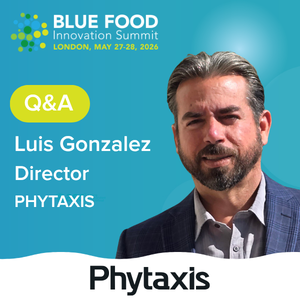
Ahead of the Blue Food Innovation Summit, we spoke with Luis Gonzalez, Director at Phytaxis, to explore where advanced feed solutions are delivering real impact in aquaculture today. The conversation examines functional additives, adoption barriers, risk‑sharing models, and the performance metrics that truly matter when scaling feed innovation from trials to commercial reality.
Where do you see the strongest near‑term opportunities for advanced feed solutions, and what measurable improvements are farmers actually realising from these tools today?
I think functional feed additives are going to play a major role going forward. Right now, the industry is heavily focused on feed cost and feed price, which is pushing formulations toward higher inclusion of lower-cost ingredients like soy. The challenge is that these formulations aren’t always optimal for gut health or the microbiome of the animal. That creates a clear opportunity for functional solutions that can offset the downsides of these cost-driven diets.
Additives that improve digestibility, feed conversion efficiency, and gut health are becoming increasingly valuable because they allow producers to maintain performance while working with more aggressive, plant-based formulations. Whether that’s plant-based extracts, amino acids, probiotics, or prebiotics, these tools are essentially enabling farmers to get more out of every kilogram of feed.
What we’re also seeing is that when you improve the underlying health of the animal, the rest of the production metrics tend to follow. You get better feed conversion, lower feed usage, reduced mortality, and less reliance on antibiotics. Ultimately, that translates into a more efficient production system and a higher quality end product, which is increasingly important in the market.
Alongside this, there’s growing interest in alternative protein sources - such as insect meal or synthetic proteins. These have strong long-term potential from both a sustainability and supply perspective, but they still require significant advancement to become commercially viable at scale. Cost, consistency, and supply chain development remain key barriers.
So in the near term, I see functional additives as the most immediate and scalable opportunity, because they deliver clear, measurable economic returns within existing production systems, while alternative proteins remain more of a longer-term play as the economics improve.
What key lessons have emerged from early adopters of feed technologies, and how should the wider industry apply these insights?
One of the key lessons from early adopters is that adoption has to be driven by data - both scientific and commercial. On one side, it’s critical to have strong scientific validation. That means in vitro and in vivo studies that clearly demonstrate the mechanism of action and show improvements in the specific parameters you’re targeting—whether that’s gut health, digestibility, or immunity.
But just as importantly, you also need real commercial validation. Products have to prove themselves under actual farm conditions, not just in controlled environments. That’s ultimately what builds trust and drives adoption.
A big learning here is that how you run commercial trials matters just as much as the product itself. Trials need to be structured with clear, consistent protocols - keeping variables as controlled as possible - so you’re not comparing apples to oranges. Without that, even good solutions can appear inconsistent or fail to demonstrate their true value.
Another important point is expectation management. These technologies are not “magic
solutions.” If there are underlying issues on the farm - such as poor water quality, disease pressure, or suboptimal management—then even the best feed solutions may not deliver visible results.
So the takeaway for the industry is twofold:
• Combine rigorous science with high-quality, well-structured commercial trials
• Take a holistic view of farm performance, where feed solutions are one part of a
broader system, not a standalone fix
That’s what ultimately leads to credible, scalable adoption and more consistent results across different farming environments.
What are the biggest technical, financial, operational, or behavioural barriers slowing the adoption, and what will it take from industry, investors, or regulators to overcome them?
I think the biggest barrier to adoption is ultimately financial risk. For most farmers, feed already represents 50–70% of their operating costs, so anything that increases the feed bill—even slightly - is immediately viewed with caution. Functional additives or advanced feed solutions are often seen as an additional cost, rather than something that will improve overall economics.
The challenge is really one of perception. These solutions need to be viewed not as a cost, but as an investment in efficiency. When they work as intended, they can:
• Improve feed conversion and reduce total feed usage
• Lower mortality and disease-related losses
• Reduce reliance on antibiotics and other treatments
• Deliver a more consistent, higher-quality end product
So while there may be an upfront increase in cost, the net effect should be a reduction in cost per kilo produced and improved margins. To overcome this barrier, there needs to be alignment on both sides:
From solution providers:
More flexible commercial models—such as performance-based pricing, phased adoption, or trial-based entry points - can help reduce the perceived risk for farmers.
From producers:
A shift in mindset is needed to evaluate these products based on return on investment, not just upfront cost. That means looking at total production economics rather than just the feed invoice.
Ultimately, adoption will accelerate when farmers have both the confidence and the financial structure to test these solutions without taking on disproportionate risk.
Where is investment growing most rapidly within feed innovation, and which financing models are proving most effective?
Over the past few years, we’ve seen significant investment flowing into alternative feed
solutions, particularly functional feed additives and alternative protein sources.
A big driver behind this is food security. As global demand for protein continues to grow, the industry is under pressure to produce more food, more efficiently, and more sustainably. At the same time, there’s increasing focus on sustainability, animal welfare, and product quality especially in aquaculture, where there is still some skepticism from consumers.
As a result, investment is targeting solutions that can:
• Improve feed efficiency
• Reduce antibiotic use
• Lower mortality rates
• Deliver a more consistent, high-quality product
There’s also a broader recognition that aquaculture, when done well, is a more efficient and scalable alternative to capture fisheries, which is further accelerating interest and capital into the sector.
In terms of what’s working commercially, the key trend is around de-risking adoption for farmers. Some of the most effective models include:
• Embedded solutions in feed
Incorporating functional additives directly into premixed feed makes adoption seamless
and reduces the operational burden on farmers.
• Performance-based pricing
Particularly in early-stage adoption, tying cost to results helps build trust and reduces
perceived risk.
• Trial-based models
Free trials, pilot programs, or “no result, no pay” agreements are proving very effective
in getting farmers to test new solutions.
• Flexible financing structures
Models such as payment at harvest, input financing, or subscription-based approaches
help ease cash flow pressure and make adoption more accessible.
Ultimately, the most successful approaches are those that align incentives and reduce
upfront risk, making it easier for farmers to adopt new technologies without compromising their financial stability.
Which types of partnerships are proving most effective in moving solutions from pilot to commercial scale—and what makes these collaborations work?
The most effective partnerships are those that involve all key stakeholders from the beginning - the farmer, the feed company, and the additive or technology provider.
When there is strong alignment and open dialogue between all three, the chances of success increase significantly. Ultimately, all stakeholders benefit from the same outcome: better farm performance and more consistent production, so aligning around that shared goal is critical.
A key factor in making these partnerships work is transparency and data sharing. Openly sharing farm data—such as growth rates, mortality, and feed conversion - allows everyone to clearly evaluate whether a solution is delivering value. That level of honesty builds trust and makes it much easier to scale successful products.
Another important element is taking a longer-term approach to validation. Rather than relying on single-cycle trials, the most successful partnerships run multi-cycle trials across different conditions, which improves the reliability of results and gives farmers greater confidence in the product.
Finally, risk-sharing mechanisms play a big role. This can include:
• Flexible payment or financing options
• Trial-based agreements
• Support from suppliers during the adoption phase
These approaches reduce the burden on the farmer and make it easier to move from pilot to full commercial implementation.
In the end, the partnerships that scale successfully are those built on alignment,
transparency, and shared risk, combined with a long-term commitment to proving consistent results in real farm conditions.
Which performance metrics really prove impact in novel feeds - and which are just noise?
All metrics provide value, but some have a much more direct and meaningful impact on a farm’s bottom line. The most important is feed conversion ratio (FCR). When farms are spending 50–70% of their operating costs on feed, the fastest and most visible way to improve profitability is by reducing that feed bill. That’s where functional feeds can have a very clear and compelling impact - by improving how efficiently feed is converted into biomass.
Beyond FCR, survival and growth velocity are also critical. Higher survival means more fish to sell, and faster growth shortens the production cycle - both of which translate directly into improved economics and better cash flow for the farmer.
There are also health-related metrics, such as reductions in antibiotic use. These do carry a cost benefit, and they’re increasingly important from a regulatory and market-access perspective as well.
Then you have more technical indicators—like immune markers, gut health parameters, or meat quality. These are valuable from a scientific and validation standpoint, but their impact is often more indirect.
Ultimately, the key metric that consistently drives decisions is FCR, because it’s the most immediate and tangible lever on profitability.
What’s holding next‑gen feeds back from moving beyond pilots into commercial Adoption?
What’s holding next-gen feeds back is ultimately cost and perceived risk.
From the farmer’s perspective, these products are often seen as an additional cost on top of the feed bill, rather than as an investment that generates a return. And in a business with tight margins, that distinction matters a lot.
The bigger issue, though, is downside risk. If a next-gen feed or functional ingredient doesn’t perform, the farmer absorbs the loss. That creates a natural hesitation - especially when the upside, while promising, isn’t always guaranteed.
Because of that, there’s a clear need for risk-sharing models between farmers and suppliers. Without that alignment, adoption will continue to stall.
There’s also a persistent gap between trial results and commercial confidence. Even when trials show strong performance, farmers are often reluctant to scale those solutions across full operations. What works under controlled conditions doesn’t always feel reliable at commercial scale - and again, that ties back to risk.
So while cost is the visible barrier, the real issue underneath is who carries the risk if it doesn’t work.
How close is the sector to bankable offtake agreements, and what risk‑sharing models work best?
We’re actually quite close - these kinds of agreements already exist in parts of the industry. But scaling them requires much stronger alignment and dialogue between all stakeholders: feed producers, farmers, and next-gen ingredient companies.
A big part of that is data sharing. To build confidence and move toward bankable agreements, there needs to be transparency around full-cycle performance - focusing on the parameters that matter most to the farmer, like FCR, survival, and harvest outcomes.
To really accelerate adoption, there also needs to be clear risk-sharing mechanisms. Right now, too much of the risk sits with the farmer. The models that seem to work best are:
• Co-funded or fully funded trials, where suppliers have skin in the game
• Joint ventures or long-term partnerships, aligning incentives across the value chain
• Performance-linked structures, where returns are tied to measurable outcomes
Crucially, it’s not enough to prove performance in a single trial. What really builds confidence is consistent results across multiple production cycles, including under challenging conditions and different seasons. That’s what turns a promising result into something commercially credible.
Ultimately, the shift is from selling inputs to building shared-outcome models. Once everyone is aligned around the same economic result - and that performance is proven repeatedly - it becomes much easier to move from pilots into true commercial adoption.
Which feed ingredient innovation is changing how feed is designed, validated and scaled and what are the most exciting ingredients?
What’s really changing the feed industry right now is the rise of functional additives—things like phytogenics, organic acids, and similar solutions. They’re gaining traction because they’re easy to adopt. They don’t require a major reformulation or take up a large percentage of the feed—they can be integrated as additives, which makes them far more practical for feed producers to implement. That’s why you’re now
seeing major feed companies launching their own lines of these products - they’re responding directly to growing demand from the market.
In contrast, more advanced innovations like alternative proteins - including insect meal and other novel ingredients - are likely to see slower adoption. The main constraint is still economics. These ingredients remain significantly more expensive than traditional protein sources, and because they need to be included at higher levels in the formulation, the cost impact is much more substantial.
The technology behind these ingredients is progressing quickly, but the bottleneck is no longer technical - it’s commercial viability.
So the shift we’re seeing is:
• Fast adoption of low-inclusion, functional additives that deliver measurable performance
improvements
• Slower uptake of high-inclusion ingredients that require structural changes to feed
formulation and cost structures
Ultimately, the next phase isn’t about proving that these innovations work - it’s about making them financially viable for farmers and practical for feed companies to incorporate at scale.
Luis will take to the stage at the Blue Food Innovation Summit to explore these themes in more detail during the session “Feed Strategy Beyond Novelty: Offtake Agreements, Viability Metrics and Real Value.” Joined by fellow experts from BioMar, Alianza, and Cargill, the discussion will unpack what it really takes to move feed innovation from promise to performance — and from pilots to scalable, bankable adoption.
Secure your ticket today to be a part of the conversations shaping the future of blue food.
)
)
)
)
)